
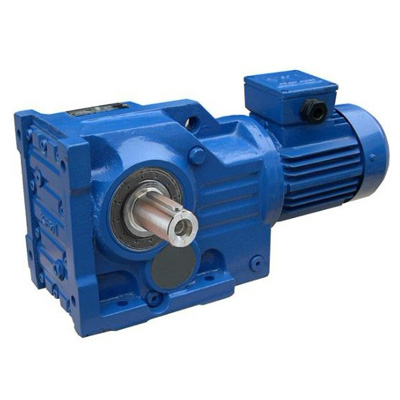
Worm gear reducer (Worm Gearbox) is a common mechanical transmission device and is widely used in industries such as lifting, transportation, mining, metallurgy, packaging, and food processing. With its compact structure, large transmission ratio and good self-locking performance, worm gear reducers play an important role in modern industry.
Structural Principle of Worm Gear Reducer
Worm gear reducers are mainly composed of worm gears, worm wheels, bearings, housing, etc. Worm gears are usually made of steel and achieve high transmission ratio reduction by meshing with the worm gear. The worm and the worm gear are meshed by helical teeth, which belongs to non-coplanar and non-parallel shaft transmission and has unique spatial transmission characteristics.
Its transmission principle is similar to that of a screw driving a nut to rotate, with the worm being the driving part and the worm gear the driven part. Due to the relatively large friction, it comes with certain braking and self-locking functions.

Key Technical Parameters
When designing and selecting worm gear reducers, the following technical parameters are of vital importance:
- Transmission ratio (i) : Generally can reach 10:1 to 60:1, or even higher;
- Center distance (a) : The distance between the worm shaft and the worm gear shaft, which affects the torque capacity and structural dimensions.
- Worm gear head count (Z1) : Commonly 1 or 2 heads, which affects the output speed and stability;
- Worm gear number (Z2) : Directly related to the transmission ratio;
- Pressure Angle and helix Angle: Affect meshing efficiency and strength;
- Efficiency: Usually between 30% and 90%, depending on factors such as load, lubrication, and pressure Angle.
Performance Characteristics and Advantages
The core performance characteristics of worm gear reducers include:
- High transmission ratio: Large deceleration can be achieved with a single stage.
- Compact structure: Suitable for equipment installation with limited space;
- Self-locking function: It has the ability to prevent reverse rotation at certain angles and can be used in lifting devices.
- Smooth transmission and low noise: Suitable for occasions with high noise requirements;
- Strong load-bearing capacity: especially when bronze worm gears are used in combination with quenched worm gears.
However, there are also certain drawbacks, such as relatively low efficiency (especially under high load and low speed) and large heat generation.
Lubrication and Heat Dissipation Design
Worm gear reducers have relatively large friction during operation, so lubrication and heat dissipation are particularly important.
- Lubrication method: Commonly used is oil bath lubrication or forced lubrication. The oil level and oil quality need to be checked regularly.
- Lubricating oil selection: It is recommended to use dedicated worm gear lubricating oil, such as extreme pressure gear oil.
- Heat dissipation structure design: Common methods include installing heat sinks, fans, or using aluminum alloy boxes to enhance heat dissipation efficiency.
Good lubrication and heat dissipation design not only enhances efficiency but also extends the service life of the equipment.
Typical Application Scenarios
Worm gear reducers are commonly found in the following industrial applications:
- Lifting equipment: such as electric hoists and winches, taking advantage of their self-locking properties;
- Conveyor line system: Provides stable power output;
- Packaging and printing machinery: It has high requirements for position control accuracy and low noise.
- Food processing equipment: Compact structure, easy to clean;
- Medical equipment: Small worm gear reducers are used for precise control.

Selection and Maintenance Suggestions
When selecting the type, the load type, working environment, expected service life and space limitations need to be comprehensively considered:
Selection suggestions:
Select the appropriate reduction ratio according to the working conditions;
Pay attention to whether the output torque meets the requirements;
Ensure that the installation dimensions match the equipment;
Maintenance suggestions:
Change the lubricating oil regularly;
Check for any leakage or abnormal noise of the shaft seal;
Pay attention to the connection accuracy between the motor and the reducer to prevent premature damage to the bearings.

Conclusion
Worm gear reducers, with their unique structure and excellent performance, have occupied an important position in industrial automation equipment. Mastering its key technical points not only helps with correct selection and application, but also enhances the reliability and efficiency of the entire machine system. In the future, with the advancement of materials and manufacturing processes, worm gear reducers will continue to play a significant role in more high-end applications.