
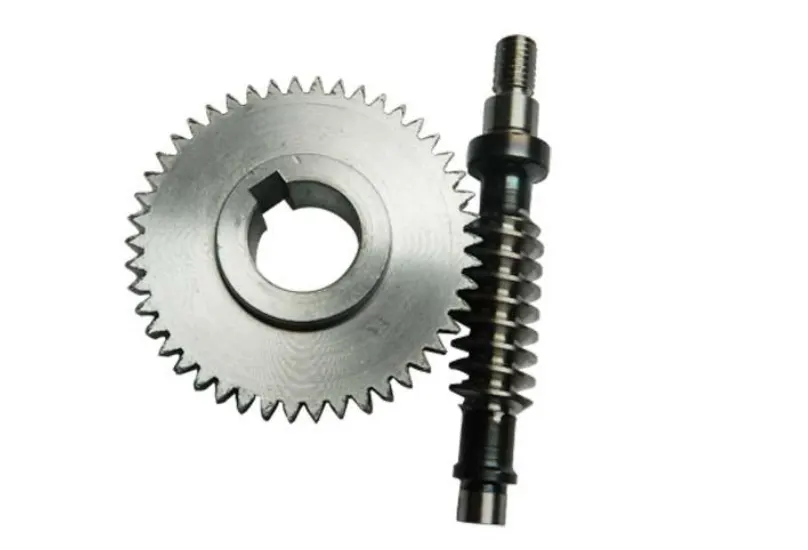
Today, as the wave of industry 4.0 sweeps the world, the performance of mechanical transmission systems directly determines the stability and efficiency of equipment operation. As the “golden combination” in the field of transmission, the material selection of worm gears and worms is not only a technical decision but also a strategic choice for enterprises to enhance their competitiveness. This article will deeply analyze the impact of material selection on transmission efficiency, service life and overall cost, providing enterprises with a scientific material selection guide.
Material Selection
Worm shaft material: The art of balancing hardness and toughness
The mainstream materials for worm wheels are mainly medium carbon alloy steels (42CrMo, 40Cr) and carburized steels (20CrMnTi). After quenching and high-temperature tempering treatment, 42CrMo steel achieves a hardness of HRC28-32, featuring both high strength and toughness as well as impact resistance. It is particularly suitable for heavy-load and high-speed scenarios. After a certain automobile manufacturing enterprise adopted this material, the service life of the reducer increased by 40% and the failure rate decreased by 25%.
For extreme working conditions, carburized steel undergoes surface hardening treatment (surface hardness HRC58-62) to form a “hard shell and soft core” structure, which not only ensures surface wear resistance but also maintains core toughness. After gas nitriding treatment, the surface hardness of 304 stainless steel can reach HV800-1100, and it performs well in humid and corrosive environments.

Worm gear material: A precise choice for reducing friction and resisting corrosion
Tin bronze (ZCuSn10P1) occupies the high-end market with its self-lubricating property and wear resistance. Its 10% tin content formula reduces the coefficient of friction by 30%, and its service life is three times that of cast iron. After a certain wind power enterprise adopted this material, the maintenance cycle was extended from twice a year to once every three years, saving over one million yuan in costs annually.
Aluminum bronze (ZCuAl10Fe3) performs well in strength, but its coefficient of friction is 15% higher than that of tin bronze, so it needs to be matched with worm gears of higher hardness. Although cast iron is low-cost, it is only suitable for low-speed (<5r/min) and light-load (<10kN) scenarios. After a certain food machinery enterprise used cast iron worm gears, the failure rate increased by 200%, and it was eventually forced to upgrade the material.
Performance Impact: Material selection determines the fate of transmission
The leverage effect of transmission efficiency
For every 10HRC increase in material hardness, the transmission efficiency can be enhanced by 2-3%. The combination of carburized steel worm and tin bronze worm gear achieves an efficiency of 92% under heavy-load conditions, which is 8 percentage points higher than that of the cast iron combination. After upgrading its materials, a certain logistics enterprise reduced the energy consumption of its sorting system by 15%, saving over 500,000 yuan in electricity fees annually.
However, excessive pursuit of hardness may lead to an increase in brittleness. After a certain mining machinery enterprise adopted hard alloy worm gears, a fracture accident occurred due to insufficient toughness, resulting in a direct loss of over 2 million yuan. This confirms that the selection of materials needs to find the golden balance point between hardness and toughness.